
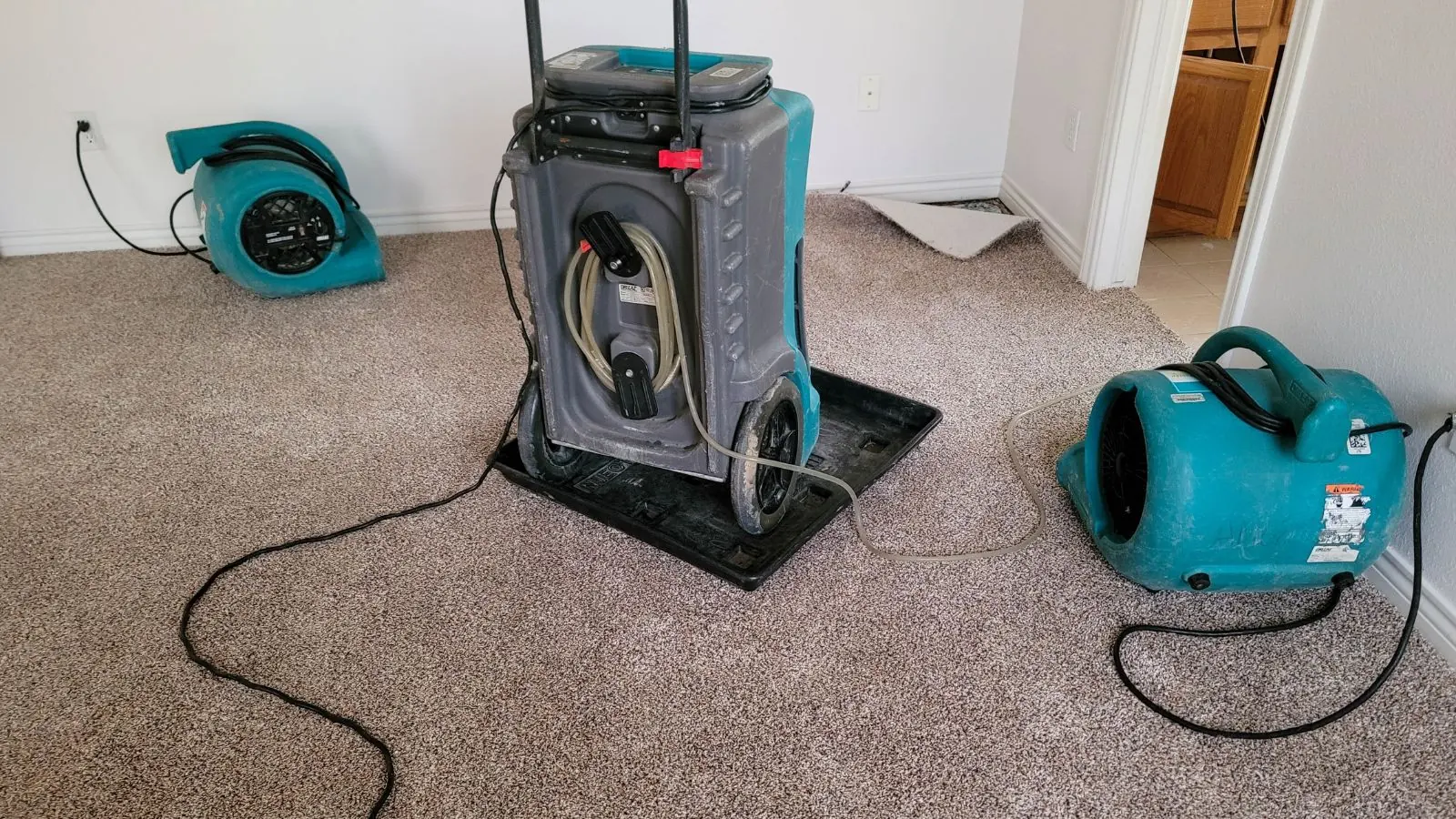
Water damage restoration is the work of stopping unwanted water, removing it, drying the structure, cleaning what was touched, and rebuilding what cannot be saved. In Evergreen, CO that work looks different from a flat-land city job, because mountain homes have crawl spaces, steep lots, wells, and cold snaps that change how fast things dry. The goal in every case is the same: a structure that reads dry on the meter, not just one that looks dry.
Many people use "restoration," "mitigation," and "repair" as if they were one thing. They are separate stages, and knowing the difference helps you read an estimate and ask better questions.
The five phases, in order
A well-run job moves through the same sequence whether the cause is a pipe, an appliance, or a storm. Skipping or reordering a phase is where most failed jobs go wrong.
Stop the source
Close the shutoff, fix or isolate the leak, or wait for outside water to recede. Nothing dries while water keeps arriving.
Extract standing water
Pumps and extraction units pull bulk water from floors and low spots, which removes far more moisture than fans alone.
Dry the structure
Air movers, LGR dehumidifiers, and sometimes injection drying systems pull moisture out of walls, subfloors, and framing.
Clean and sanitize
Surfaces, contents, and cavities are cleaned, and anything contaminated is treated or removed. HEPA air scrubbers may run when dust is a concern.
Repair and rebuild
Drywall, flooring, trim, and paint are replaced where removal was needed.
Restoration, mitigation, and repair are not the same
Mitigation is the first half: stopping the source, extracting water, and drying. It limits the damage and is usually the urgent part. Our water mitigation service is built around that early stage.
Repair is the second half, the carpentry and finishing. It is covered by water damage repair, which replaces what the water ruined. Restoration is the umbrella term for the whole path from wet to finished.
The order matters. Rebuilding on top of structure that has not been verified dry invites staining, swollen trim, and mold.
Water comes in three categories
The published industry standard, ANSI/IICRC S500, sorts water into categories based on how contaminated it is. The category drives which materials can be saved and what protective gear the crew wears.
| Category | Typical source | What it means for materials |
|---|---|---|
| Category 1 | Broken supply line, tub overflow with clean water | Most materials can be dried, if the job is caught quickly |
| Category 2 | Washing machine or dishwasher discharge, sump overflow | Possible contamination, so porous items are often removed |
| Category 3 | Sewage, creek or river flooding, standing water that sat | Grossly contaminated, so porous materials are normally removed |
Water can also move up a category with time. Clean water that sits in carpet for days picks up bacteria and can no longer be treated as clean. That is one reason crews push to start fast.
You do not need to memorize the standard. You can simply ask any company whether its crews work to S500 and how they classified your water.
How crews know when it is dry
Drying is a measured process, not a time-based one. A moisture meter reads materials by touch or by pin, a thermal imaging camera shows temperature differences that can reveal wet areas behind surfaces, and a hygrometer tracks the humidity in the air. Crews set a drying goal by taking a dry reference reading from an unaffected part of the house.
Each day the crew re-reads the same points and logs the numbers. When the wet materials match the reference, the equipment comes out. If they do not, the equipment stays or the plan changes.
Those logs are valuable beyond the job. They document what happened, what was wet, and how it dried, which many insurers find useful when reviewing a loss.
What good documentation looks like
Ask what the company records. A solid file typically includes photos before and after, a sketch of the affected rooms, the category and class of the water, daily moisture readings, and a list of equipment set and removed.
This paperwork is not a formality. It lets you compare what you were told with what was done, and it supports your conversation with your insurer. Your policy and your insurer decide what is covered, so ask them directly.
When water damage becomes a repair job
After drying, some materials will not recover. Drywall that has gone soft, carpet padding that took Category 3 water, and swollen laminate flooring are removed. Once the structure is verified dry, repair begins with new material.
The rule holds across trades: remove what cannot be cleaned, dry what is behind it, then rebuild. A repair crew may also coordinate with a plumber or electrician when the affected walls hold lines that need inspection.
When the problem is the utility, not the house
Evergreen Metropolitan District provides the community's drinking water and wastewater service. According to the district, it owns and operates one water treatment plant, eight water pump stations, ten water reservoirs, one wastewater treatment plant, three wastewater pump stations, and about 300 miles each of wastewater collection pipe and water distribution pipe. It also operates the water system for West Jefferson County Metropolitan and Kittredge Sanitation and Water.
With that much pipe, a main break or boil order is possible, and it is a utility problem, not a problem inside your walls. If water is coming from the street, a district main, or a service line outside your meter, call the district. Restoration begins inside the home, with water that has already entered, so you may need both calls.
A leak on your side of the meter is yours to stop, and a restoration crew can extract and dry what entered the house. Homes in Indian Hills have a different setup, since the Indian Hills Water District serves part of the community and other homes use private wells and septic.
Safety before any work begins
Before you touch anything wet
- Treat standing water as electrified until the power to that area is shut off or an electrician says otherwise.
- Assume floodwater and sewage are contaminated and keep children, pets, and bare skin out of it.
- Do not use a household vacuum on water.
- If you see a sagging ceiling, stay out of the room, since it can fail without warning.
- If there is a gas smell, leave the building and call the gas utility.
What affects the scope of a job
Every job is sized by factors, not a formula. The source and category of water, how long it stood, how many rooms and floors were reached, the materials involved, and whether walls and insulation are wet all matter. Access also plays a part, such as crawl spaces and finished basements.
You will see no flat numbers here because an honest scope needs eyes on the structure. Want your real number? Call (303) 952-8295 and describe what happened. Crews serving Morrison and other nearby areas start from the same questions.
Water in the house right now?
Call around the clock for same-day response when available.
Frequently asked questions
What is the difference between water damage restoration and mitigation?
Mitigation is the early work of stopping the source, extracting water, and drying. Restoration covers that plus cleaning and rebuilding. Many jobs include both, in that order.
How long does it take to dry a house?
It depends on the water category, the materials, and the humidity, and crews work to meter readings instead of a set number of days. Ask the crew what the dry reference reading is and how often they will re-check.
What is ANSI/IICRC S500?
It is a published industry standard for professional water damage restoration. Ask any company you are considering whether its crews work to it and how that shows up in their drying logs.
If Evergreen Metropolitan District has a main break, is that a restoration job?
The break itself is the district's to repair. If water entered your home, restoration handles the extraction and drying inside. Tell your insurer and the district about the event so both records match.